


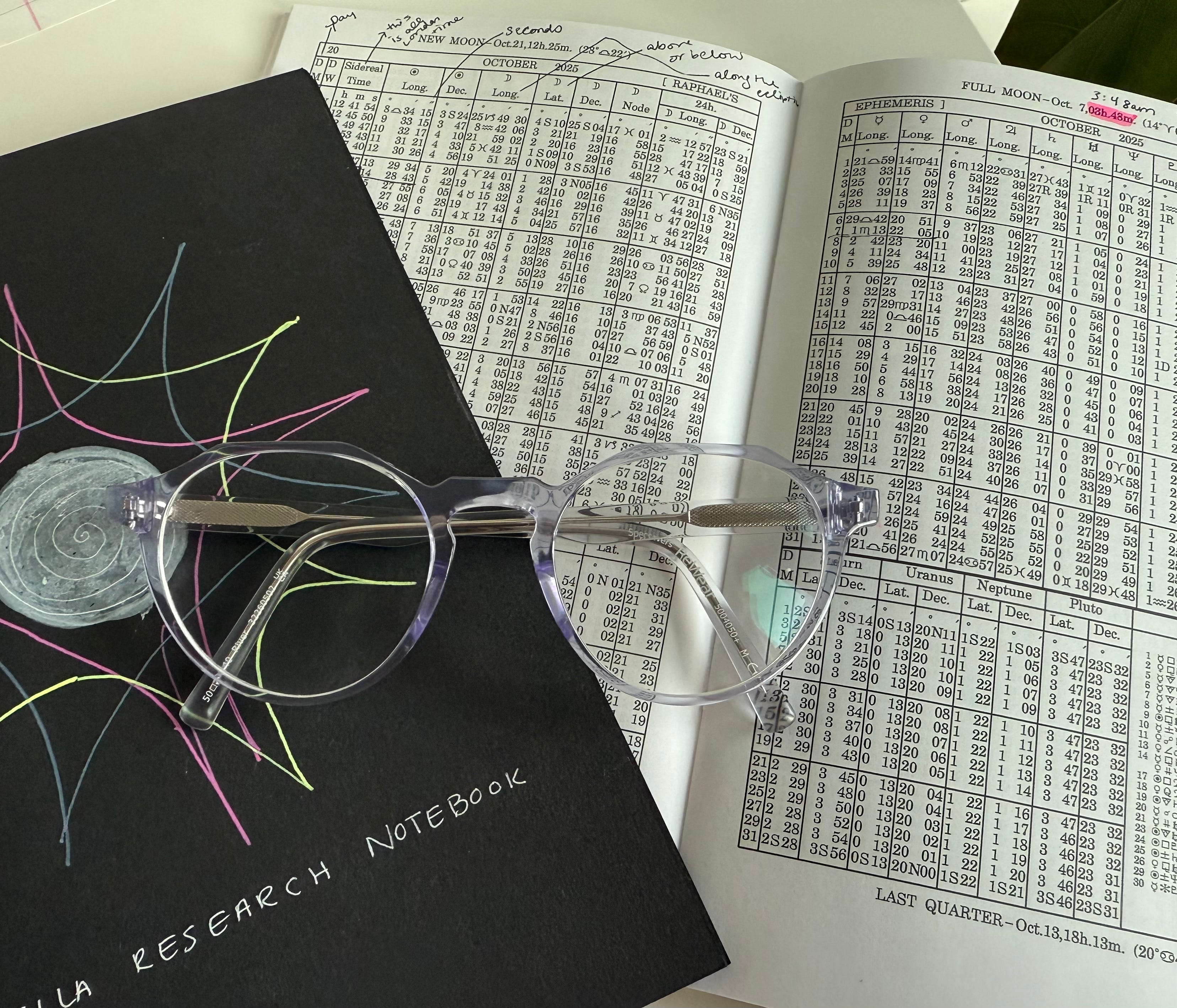
I have just turned in my final assignment for astrology school this term, and I’m reflecting on how much I’ve learned in such a short amount of time. More parts of my own chart and the charts of others have come alive for me, including aspect patterns created between planets, the angles that form the cross of matter, the nodal axis, and the natal lunar phases (which I’m including as a fun little bonus at the end of this newsletter for self-reflection).
One thing that has been especially challenging and rewarding this term has been learning how to calculate different points in the birth chart by hand. This means being able to draw up a person’s natal chart using nothing but the birth time and place, a physical ephemeris, and a calculator. Of course, these days, we plug the information into an online program and have a beautiful chart drawn up in seconds, but learning the analog process has humbled and stretched me in all sorts of ways.
For one, I was never fond of math growing up; I struggled to understand it as a language that undergirds our physical reality, and instead saw it as a chore of small calculations. But math, as I’ve come to use it, is such an effective way to keep track of the planets and angles as they move, as well as orient us in time and space. There are so many variables in different systems to keep track of when we study astrology. This includes the Earth’s tilt, the seasons, the movement of the planets, calculating between time zones, and understanding the difference between sidereal time (the Earth’s rotation relative to the stars) and tropical time (the Earth’s rotation relative to the Sun). So, the process grounds me in the physical reality of how the planets move together as a system, and gets me thinking about the night sky more intimately.
Second, it has connected me to the long line of inquiry that makes up the framework of astrology and astronomy. While the tools don’t have to be complex, the ideas certainly are, as they have been built incrementally over millennia. For example, the ancient Greek mathematician Eratosthenes of Cyrene accurately calculated the Earth’s circumference using sticks in 240 BCE! Sticks, can you imagine?
Separately, below the paywall, I’ll also share some of what I learned about the lunar phases and psychological astrology this term. This comes from a lesson that was adapted from Dane Rudyar’s book The Lunation Cycle and examines how the lunar phase that one was born under colors the birth chart with a specific mood or goal. I thought it was interesting, so I am sharing it for fun and reflection.
Stay tuned for next week’s New Moon Newsletter/Winter Solstice post.
So much love ♥︎,
Natasha
P.S. - I am now offering natal chart readings on a pay-what-you-can basis. If you are interested, email me at soto.natasha@gmail.com
